The idea of taste, etymologically, comes as early as the 14th century, with this so-called “discriminative faculty” being a concept directly akin to the tasting of food and drink. This classic form is usually thought of as one that describes the delineation between highbrow and lowbrow sensibility. But it’s not simply one of class differentiation - of the rich snobbishly looking down at the town square pantomime and sneering. Rather, it presumes that there is a good taste and a bad taste, and that to a certain extent, one has the ability to possess one or the other.
Capitalism’s greatest innovation, and one that continues to expand itself up to the very minute I’m writing this sentence, is the paradigm of personal decision. Of choices, of preferences, of differentiation. One’s taste is simply a matter of what one chooses, irrespective of its origin or social construct. Once an ability restricted to the grandly wealthy, this paradigm shift now affects everyone and is critical to everything.
We here at monotone proudly make use of this new paradigm, as everyone else does. At least, those on letterboxd and other such taste-signifying platforms. We have moved on from the Gen-X trap, of reducing art down to an arbitrary set of aesthetic parameters that dictate its value as real art to be viewed exclusively through a taste lens (it is fun to be a snob though). An appreciation of all forms of art on their own terms has become much more normalised. From camp, to splatter horror, to poptimism, there has been a wholesale embracing of kitschy ‘lowbrow pleasures, and their specific artistic merits. Art analysis and engagement has become less negative, things that operate in bad taste less rejected by the critical consensus altogether.
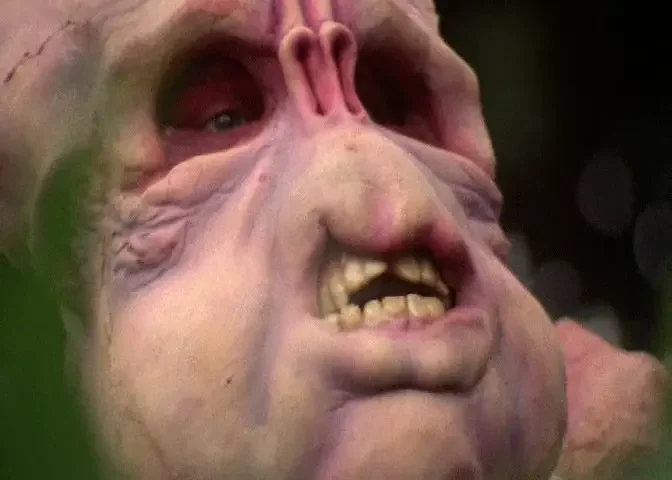
Brazen, puerile, filthy, stupid, and ultimately a film needing none of these adjectives because the cover poster has a lumpy alien creature prominently giving the viewer the middle finger in trompe l'oeil, Bad Taste is a pre-eminent example of the self-conscious complication that taste conceptually presents. The film revels in its supposed lowbrow status, like a pig proudly rolling about in the muck.
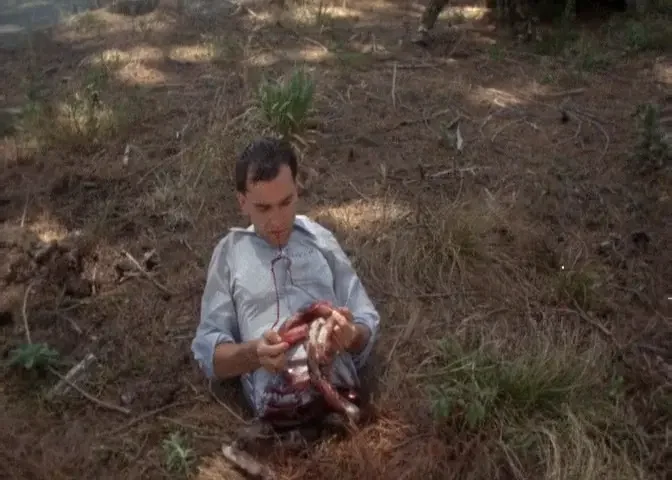
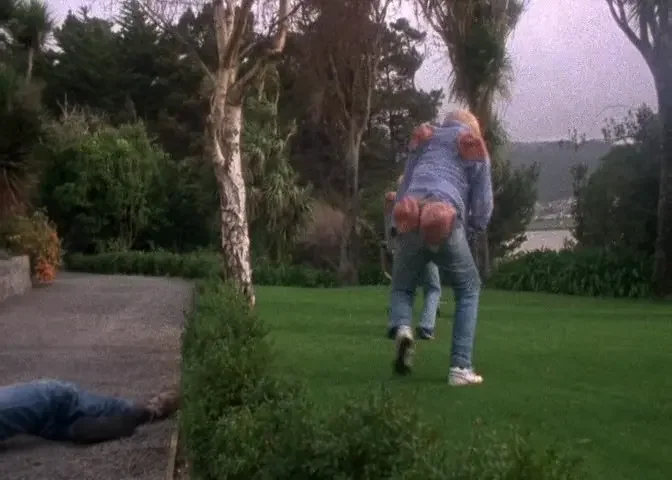
Announcing itself with titular sensibility, Bad Taste, directed by Peter Jackson, opens with a man’s skull being blown off by a nebbish government operative, the brain bits bubbling down to the pastoral New Zealand greenery. Set in a fictional sleepy town near Wellington, Bad Taste follows a group of government men who discover and fight back against a voracious group of hominid-hungry aliens.
Bad Taste is straightforward; it’s a film that nakedly takes two staple sci-fi premises “what if the Aliens are secretly taking over our bodies?” AND “what if the Alien’s end goal is to literally consume us as food?” then dials up the bodily destruction to be in line with the emerging 1980’s horror cinema, kickstarted by films like 1981’s The Evil Dead. It’s hard to avoid describing the whole film as a hazy dream of a drowsy New Zealander with a fiendish bloodlust who has fallen asleep on the couch watching The Twilight Zone.
Those that willfully or ignorantly opt out of ‘taste’ theoretically do so with the same blithe foolishness as Andrea does in The Devil Wears Prada. The colour Cerulean Blue invokes a sort of chest-thumping righteousness in every person on this earth that has to prove that caring about the art isn’t simply arbitrary colours. It’s about intention, reference, about meaning. One can play with matters of taste and deploy it in many directions. If taste is no longer the status or marker of artistic worth we then have to be less broad with our probing of it. Questions of taste, good or bad, have to be delivered with a more precise framing.
Funnily enough, given the deliberate debasement of taste that Jackson is working toward, this relativising of taste almost makes his debut film anachronistic. The idea of bad taste, of having a lesser aesthetic taste that isn’t rooted in the more effetely highbrow, is outmoded. We can discard that idea, and focus instead on the particular qualities of a work in general, and perhaps what that work can tell us about its creator and the people that love it.
As markers of taste become less important to differentiate oneself except for personal preference, we end up quite naturally with something markedly different from aesthetes, i.e. those with ‘good taste’. We arrive at taste really only being useful to understand the collectivisation of people under the rubric of fandom. We arrive at being a fan of something. Digging through interviews and profiles of Jackson that feature mention or discussion of his debut we find the term ‘fan’ bandied about as a shorthand for Bad Taste’s presumed receptive audience: the quintessential Gen-X horror buff.
A subculture we were sadly born just too late to engage with, the Gen-X horror buff is characterised by a gore-fiend fascination with B Cinema, freaks, weirdos, and a subscription to Fangoria Magazine. These ‘fans’, among which Jackson includes himself, are perhaps the pre-eminent example of the blurring of fan & artist in cinema, right after the Cahiers du Cinéma crew.
It's good. I'm no different from any other fans. I like going to watch movies; I'm looking forward to 'Evil Dead III' as much as you guys. I'm just lucky, I guess, that I've had the opportunity to be able to make movies as well. I know that often fans make movies and some of them are very good, but I've managed to make them on 16mm and do it professionally. I guess I'm actually lucky to be living in New Zealand, because the New Zealand government are quite supportive of what I'm doing, and they've given me several million dollars to make these sorts of movies. Not many other fans around the world have got the chance to spend that sort of money!
Jackson’s Bad Taste is a debut that is a perfect demonstration of the mind behind the camera, and the circumstances of its creation. It’s a love letter; like other stereotypically film-bro-adjacent director boys his contemporary Jackson is a film obsessive. Fueled by a film diet that included a fair chunk of the cinematic sleaze seeping out from the video store, the man that would make sweeping fantasy epics and change the face of cinema (and geography) of New Zealand forever is, at heart, a lover of joyfully campy excess.
A perfect example of filmmaking run-and-gun, Bad Taste’s story is one of stubborn perseverance. Initially a short film, Jackson worked on the film over four years, shooting on the weekend with the mates he roped into the project. Describing the process as something his family around him thought akin to “banging yourself on the head with a brick on a daily basis”, he eventually wrangled some cash from the New Zealand Film Commission in order to finish the film and pay for post-production.
It feels reductive to lean on its New Zealand origin, but it’d simply be untrue not to state the obvious - it's incredibly deadpan, with every moment of horror and gore completely undercut by Jackson’s geographically recognisable black humour. Sure, it’s pretty stupid, and the bulk of the film is a handful of random men dashing about a grassy knoll with fake guns and lurid red sauce oozing around them, but it’s got heart, damn it. It’s being playful with taste (!) in a way that feels in conversation with the artistic outpouring of burgeoning 80s horror films, or even just indie films in general. Sheer gumption, and a knowing joy in the wink-wink nudge-nudge pleasures of cinematic camp, allow a ramshackle film to speak to something far bigger than just itself and its local market.
Even gorefiends can contain multitudes. That auterisum that people might ascribe to Jackson can extend beyond. The 2010s saw the population of the term vulgar auterisum, marking a reappreciation for the coherent bodies of work that filmmakers who truck in things considered more base. This reappraisal wasn’t always focused strictly on one particular theme or genre, but more broadly an understanding of popcorn cinema, i.e. lowbrow mass cinema, as something worthy of critical analysis and pleasure. The great wave that this movement was a part of ends up a new lexicon now, whereby we have largely as a culture demystified the high and low brow. This is not to say that people aren’t judgemental, that taste isn’t important - it absolutely is still considered so. It’s more that everything is accessible enough to someone that might seek it out, that the blurring of the high/low-brow film is all up for grabs and we can enjoy both without such paradigmatic judgement.
Jackson followed up Bad Taste with the gleefully lowbrow Meet the Feebles. A direct parody of the Muppets, where every single puppet character is pervertedly engaged in any number of sordid activities from snuff films to drug debt, it's just as pleasurably in bad taste as his debut. And then, shortly after that, another blood-soaked campy horror with Braindead. We then see Jackson produce the widely acclaimed Heavenly Creatures.
It's pleasing to think of the range: the same blood-soaked gore-driven lunatic frenzy, the sheer gung-ho madness that would have possessed Jackson to bother toiling over his debut film for years would also somehow drive him to make films with far less visual extremity and perhaps a bit more of a humanistic touch. Clearly he always returns to that excess though - LOTR as a whole, and certainly that one particularly gnarly sequence in his King Kong with the grotesque flesh-hungry bugs, speaks to a honed aptitude for riding that line of pleasure.
Delivering images to a hungrily waiting audience that laps up his campy excess Peter Jackson’s debut feature is truly a healthy first serve of his delicious buffet, and a useful reminder that the world was always wonderfully tasteless.