Yurlu | Country
top pick for 2025
This article references deceased Aboriginal persons. The film Yurlu | Country includes video and audio of deceased Aboriginal persons.
Yurlu | Country is, most intimately, a film about a particular place and a particular person.
We follow one year of Matiland Parker’s life, an indigenous (Banjima eldar) fighting against a mining conglomerate Hancock Prospecting that poisoned his people and his ancestral lands, as he deals with his own asbestos-induced cancer. Maitland does all that he can to work through the bureaucratic system that prevents indigenous people access to their own land. To tell this story, to plead to the masses, Maitland allows the audience into the most vulnerable parts of his life, his health, his work, and his impending death.
As the story progresses we as the audience are introduced to the pure self interest of Lang Hancock, son of George Hancock, the family that started and pushed for approval of asbestos mining in the region of Wittenoom. In his own words: “some people have to suffer so the majority can benefit from asbestos” - and haven’t we all seen so many benefits from asbestos to this day?
Hancock and the Australian government are villainised through their own words, their own actions. Perpetrated by Hancock, the Wittenoom asbestos mine catastrophe was a negligent disaster that led to the deaths of hundreds and the closure of an enormous region of Western Australia. This is regarded as one of the worst contaminated sites in the southern hemisphere. The Hancock name has, and likely will continue to, haunt for generations. Maitland’s father worked directly for the prospector whose self-titled company continues to block Traditional Owners from access to Country. Aboriginal people who have done the work to gain Native Title from the imposed western system, who are recognised as the Traditional Owners of the land, cannot even visit their Country to grieve the people they have lost due to colonial greed.
Yurlu | Country is a film that makes extraordinary use of the documentary form - it often insists on speaking to us purely through its footage. Yurlu is simultaneously an informational and narrative documentary film. It manages to juxtapose many contrasting elements together, and to complicate its own form. A personal and political existence is one taken on/forced on by Maitland and his family, and the film acts in dual capacities to express this.
In working with the director, Yaara Bou Melhem, as an executive producer Maitland exercises his deserved right to decide how to tell his story and the intimacy of our access. He is generous with us: we are let into the most private parts of his existence; to hospital rooms, family meetings, celebrations, and mournings. He does it for explicit purpose.
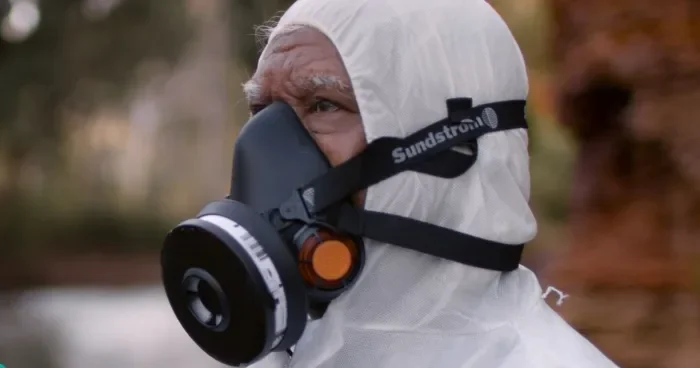
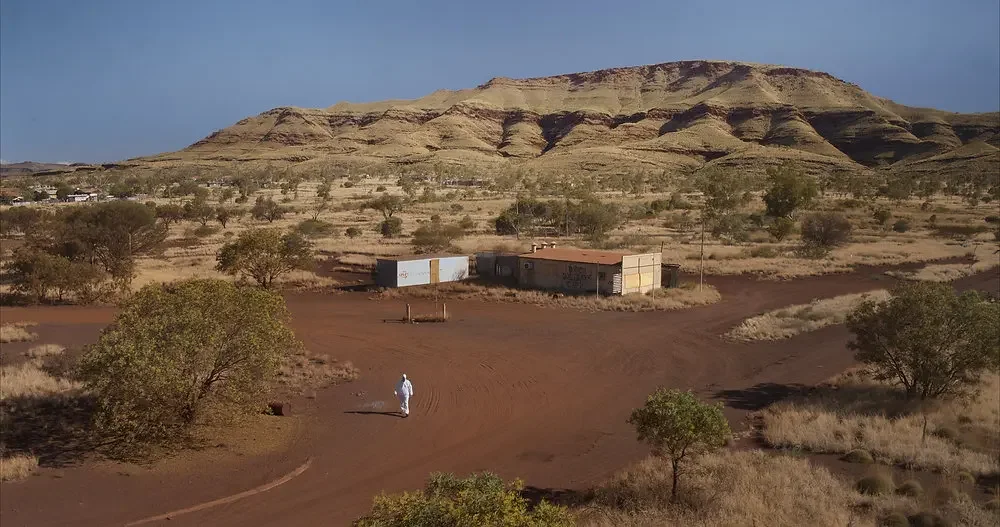
The film often eschews direct ‘telling’ or over-explanation, but rather features a mode of understanding character motivation and storytelling that works more intuitively. For example, the opening sequence has a series of particularly striking shots: An older indigenous man standing amongst the newly apocalyptic landscape of his birth, shrouded in protective white suit, gas mask on. These images, pregnant with meaning, are presented in a way that allows Maitland to be both the main character of the story, and the person who we inhabit. Throughout it allows for an embodied perspective - as we follow Maitland’s journey it feels often like we are there alongside him as witness.
While mostly works in this narrative fashion, the film only occasionally dips into something more data-driven, and this sparing use of informational graphics and voiceover is very effective. We are given large scale views of cities and landscapes, animated segments that show visual data and direct ‘fact’, that are deployed to contextualise the most interpersonal elements we have seen on-screen.
The visuals tell a story in their own right, with cuts between archival footage, purveying the exact racist overtones you’d expect, to today’s elders who have survived to tell the tale. The history and implications of colonial Australia run clear and true.
Of note are the shots displaying the landscape. Often drone footage immediately reveals itself to the viewer and is read as a sort of HDR screensaver - more youtube tech demo than ‘film’ footage. In Yurlu the sheer scale of the landscape, and of its devastation, makes the drone footage far more compelling than mere screensaver. Feeling the surveying lens moving us across the asbestos exclusionary zones, with the singular figure of Maitland often examining from below allows us to inhabit both the white prospector’s cartographic gaze, and the singular vision of Maitland as he takes in the land around him directly. We’re able to see with filmmaking omniscience a view of a beautiful and devastated landscape, a view that is afforded by the very technologies that colonisation used extractively to cause its destruction.
Striking sound design throughout the film, often seeking to express the power of the landscape, using clashes, swells, and dramatic cut-offs to propel us from one sequence to the next; to speak of the land’s power, but also the violence that has been enacted onto it.
Similar cinematic techniques of reversal or speed ramping, allow for recontextualization of the literal image itself (of sand, plants, rocks, dust, soil, and trees) to visually sing and express more than the direct meaning.
Through the use of a mixture of English and Pama-Nyungan language, through the incorporation of western and traditional medicine, we as an audience are engulfed into the dual worlds. A reminder for the audience of the duality that Traditional Owners, and anyone who is not considered ‘white Australian’, live within.
The film’s focus on healing Country, the ongoing consequences of racism in Australia and failures of Western Australian government are portrayed through a lens of truth telling.
The film is an elegy for this enormous environmentally-uninhalated region, for all the functionally murdered and exploited peoples that live there, and for Maitland himself. An incredible, detailed, specific, and moving epitaph.
A recommended watch: to seek access for screening Yurlu | Country please visit https://yurlucountry.com/.